
11.19.2026
U.S. Soy Staff Writer
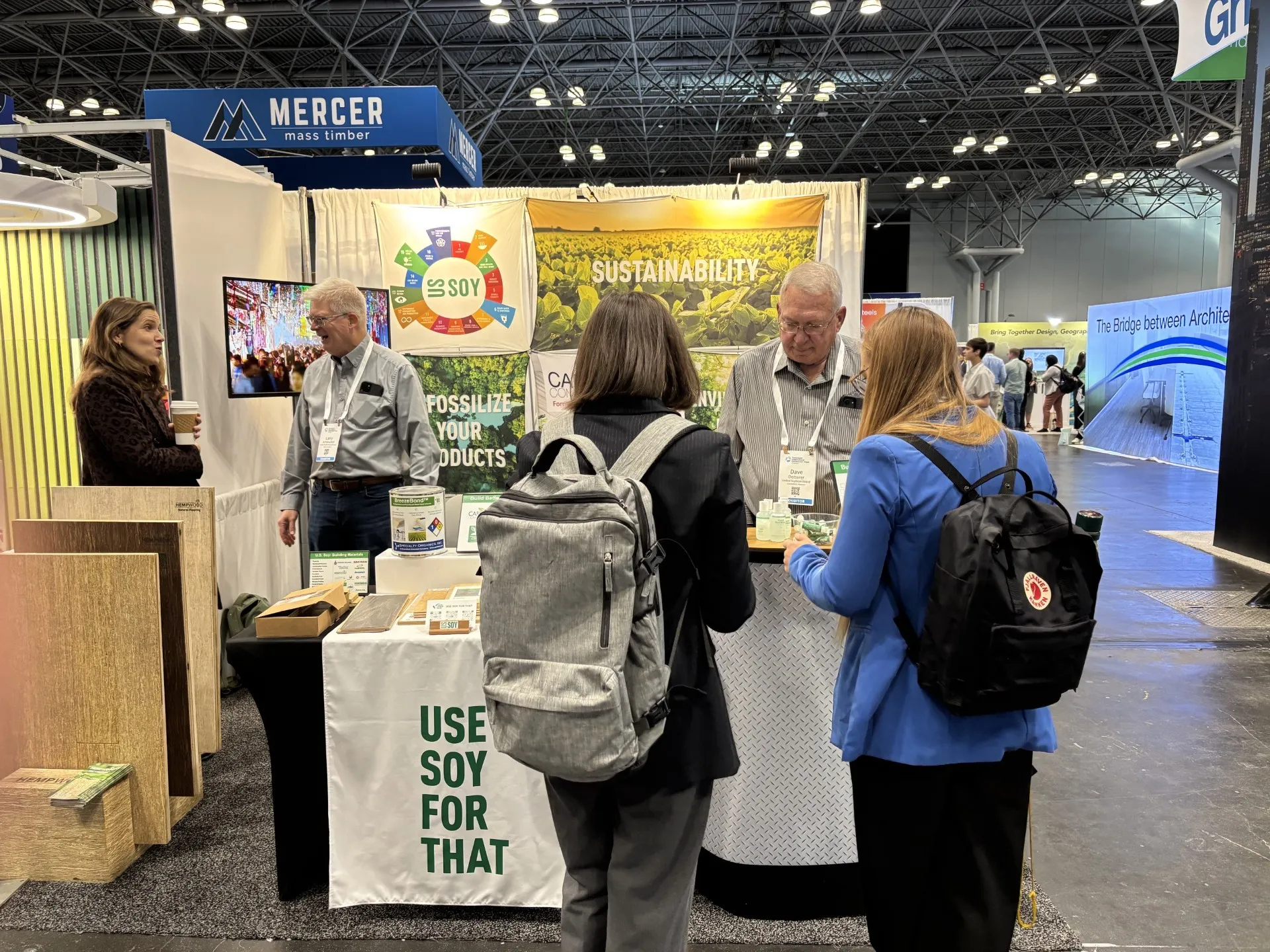
Architects, designers and builders walked the Greenbuild show floor in New York City this fall looking for their next material. At the U.S. Soy booth, they found wood adhesives, stains, concrete sealers and foam insulation made with U.S. Soy, and one of the farmers who grows it.
“Some of them were kind of surprised to be speaking with a soybean farmer. Some of them thought it was unique,” says Ohio Soybean farmer-leader Dave Dotterer. “Then they’d have a few questions about growing soybeans and how it got to be in a product like that.”
Those conversations are the reason why Soy Checkoff representatives attend. Greenbuild is one of the largest conferences in the world for green building materials, says McKenna Losby, Ph.D., United Soybean Board (USB) program director of industrial uses, and many of the technologies soybean farmers have invested in are built for that market. Omni Tech International represents USB at Greenbuild and about a dozen industry conferences each year.
Creating demand
The first job at the booth is education about what soy-based materials can do.
“Getting the word out helps other companies adopt the technologies and creates a demand pull there,” Losby says.
Wood adhesives, used to bind panels together, drew the most interest in New York, Dotterer says. Visitors liked that the products are renewable and made with “no formaldehyde or things like that.”
Adhesives are by far the largest industrial use for soybean meal, Losby says. Commercial soy-based wood adhesives are already available, and Soy Checkoff-funded researchers are working to improve water resistance to expand their use. Coatings are another growth area, with numerous research proposals submitted to the checkoff in the past year.
Losby is direct about what it takes for a manufacturer or specifier to switch.
“We really need to be at cost parity with the products out there, because people aren’t going to pay more just because it’s sustainable, most of the time,” she says. “If you can outperform the incumbent, then people might pay a little bit more.”
Answering demand
The booth also works in the other direction. Technical experts use these shows to learn where the building industry has a gap that soy could fill.
“Maybe there’s a compound or chemical that’s being phased out and a company has to find a quick replacement,” Losby says. “That’s a demand pull. We know there’s an unmet need that needs to be filled.”
Those needs shape what the checkoff funds next. So do conversations with companies and researchers developing new technologies, who can become partners on future projects.
“Every year, Omni Tech International gives us those leads, and when we put out our request for proposals, a lot of those come from interactions at these conferences,” she says.
The standard for any new project is practical.
“With these technologies, they either need to be replacing something that’s being phased out or performing better, or else why are people going to change?” Losby says.
Expertise on both sides of the booth
The Omni Tech team brings decades of industry experience to those conversations, including knowledge of what has been tried before.
“They’re able to give that historical context, which I think is huge,” Losby says.
Farmers bring something different.
“Having a farmer in the booth is such a breath of fresh air for people, because they can really see that farmer experience,” she says. “They can answer questions that a technical person wouldn’t know the answer to and then put a face with the idea of soy.”
The opportunity ahead
Losby sees the biggest opportunity for U.S. Soy in the building sector where interest was strongest at the show.
“Even though there are some commercial products out there, the opportunity for growth is so huge,” she says of wood adhesives. “Getting a big commercial wood adhesive partner would be a huge win in the industrial area.”
Dotterer left New York encouraged by the response.
“I thought we had an extreme amount of interest. A lot of people stopped and talked,” he says. “I thought it was a very good show for us.”
U.S. Soy Staff Writer
U.S. Soy provides a sustainable alternate protein, that allows our farmers to grow their businesses and feeds countless families around the world.
.webp)